
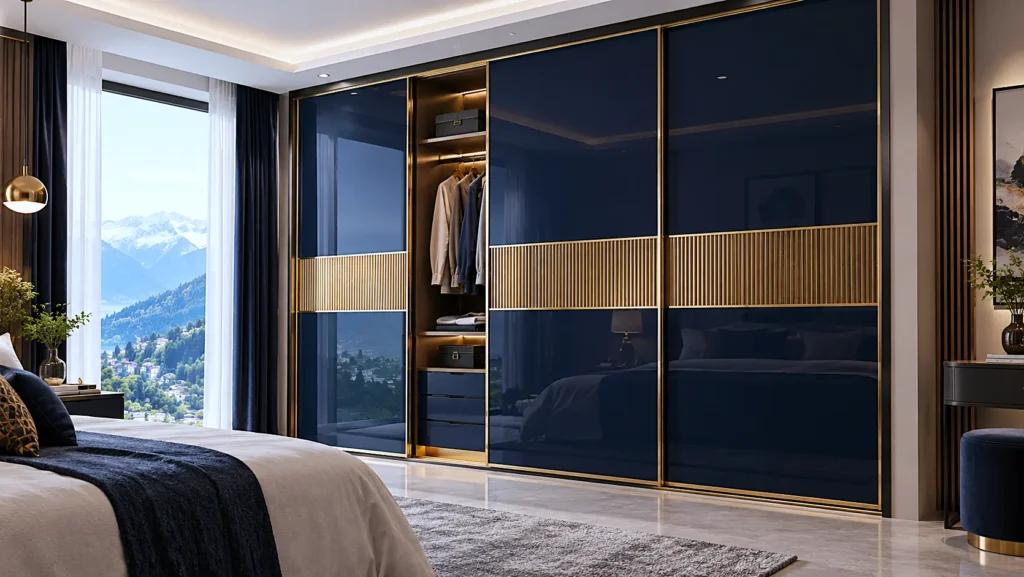
Sliding Wardrobes in Darjeeling: Smart Storage for Hill Homes
The Darjeeling house has its own personality — small rooms, slanted roofs, and a climate that changes from cold mist to torrential monsoons. In such an environment, the wardrobe has to be more than just furniture. It has to open easily in a confined space, be moisture-resistant, and store everything from winter woolen clothes to summer cotton clothes without getting damaged. This is why sliding wardrobes in Darjeeling have emerged as a practical option for homeowners looking for a wardrobe that fits into the room rather than clutters it. While open-door wardrobes take up space on the floor with swinging doors, sliding wardrobes slide from one side to another and keep your floor clear. This article discusses how sliding wardrobes function in the Darjeeling climate, what materials work, and what you can expect to pay in Darjeeling.
Why Sliding Wardrobes in Darjeeling Fit Hill Home Layouts
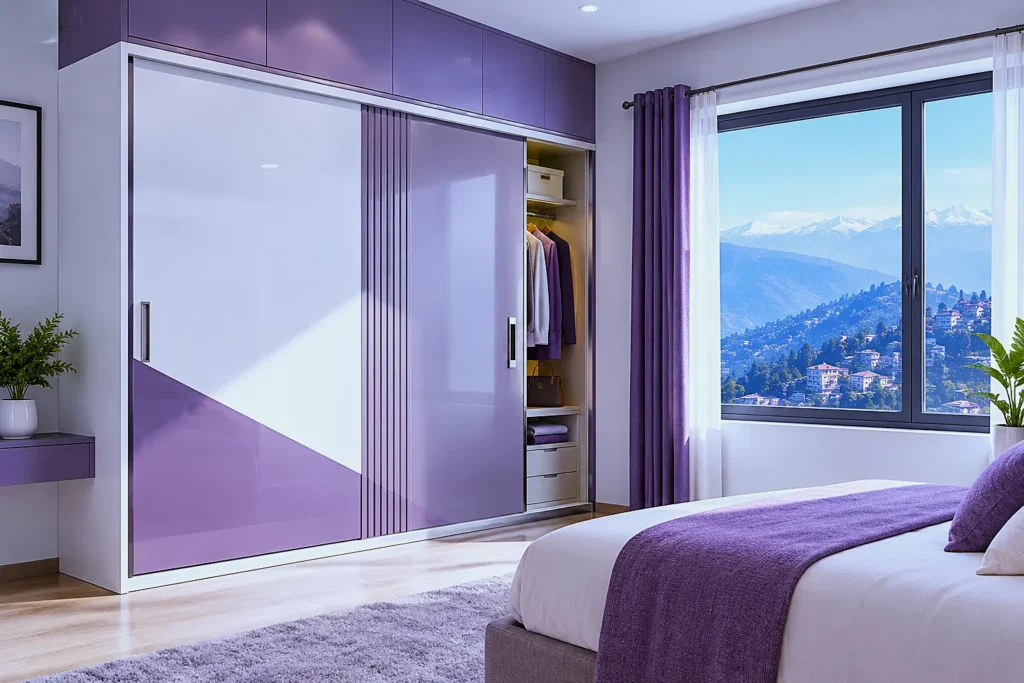
Rooms in Darjeeling do not always come big. The rental apartments and old family houses have rooms in the area of 100 to 180 square feet. Every inch of room space matters. In such rooms, opening outwards by two feet of space, a hinged wardrobe door will block the gap left between the bed and the wall. Sliding doors in the wardrobe help overcome this problem altogether. The shutters move on top and bottom tracks without needing any space for clearance at all. It is possible to put the bed next to the wardrobe and yet reach your clothes without having to squeeze through an open door.
It is no small advantage. In homes where the furniture needs to be arranged taking into consideration the windows, chimneys, or load-bearing walls, having a wardrobe door that slides changes the whole room dynamics. Open-door wardrobes will still work fine in bigger rooms, but for the smaller Darjeeling room, sliding doors become the solution.
The Humidity Question: What Darjeeling Air Does to Wardrobes
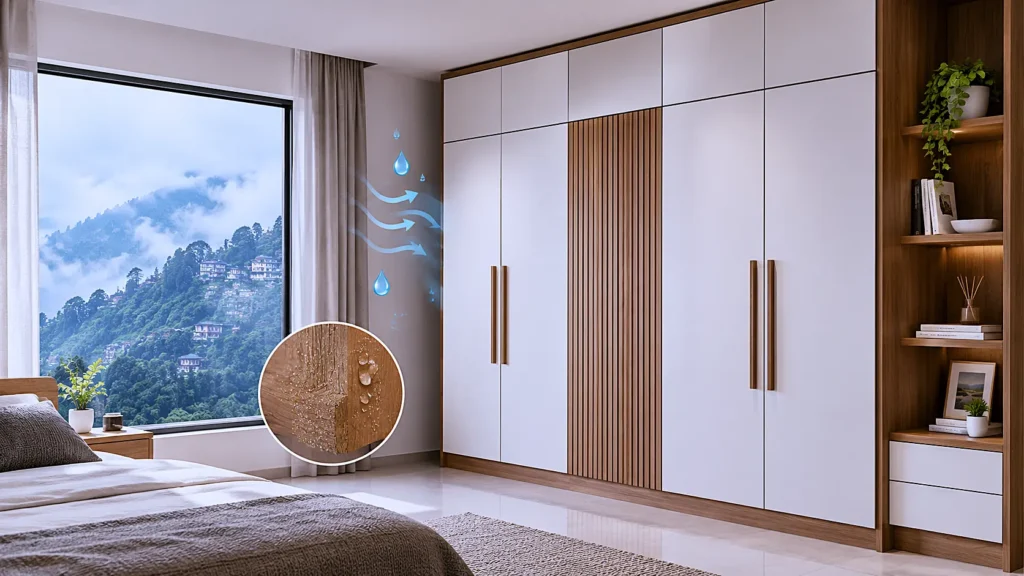
Darjeeling is a high-humidity place. In the monsoon season, the relative humidity in the hills lies between 85 percent and 99 percent. Even during dry seasons, the humidity level remains high. This is important because fabrics used in making wardrobes react differently in a humid atmosphere. Particle board, the least expensive type of engineered wood, is not very resistant to humidity and has a lifespan of about three to five years in a humid atmosphere. The MDF makes a smooth finish in painted shutters, but it takes moisture and swells up at the edges in two years’ time.
As for Darjeeling, the plywood core material recommended for this area is Boiling Water Proof plywood, which is BWP plywood. The plywood is designed to withstand long-term exposure to moisture without delamination. Furthermore, screws hold well in plywood, which allows sliders and hinges to remain strong throughout their life. Although a plywood carcass may be somewhat more expensive than a particle board one, the extra money will save you the expense of repairs later. For a sliding wardrobe to support two or three heavy shutters on the slider, the carcass of the cabinet should stay sturdy. Otherwise, a swelling or softening of the carcass may skew the slider.
Sliding vs. Open Door Wardrobes: A Fair Comparison for Darjeeling Homes
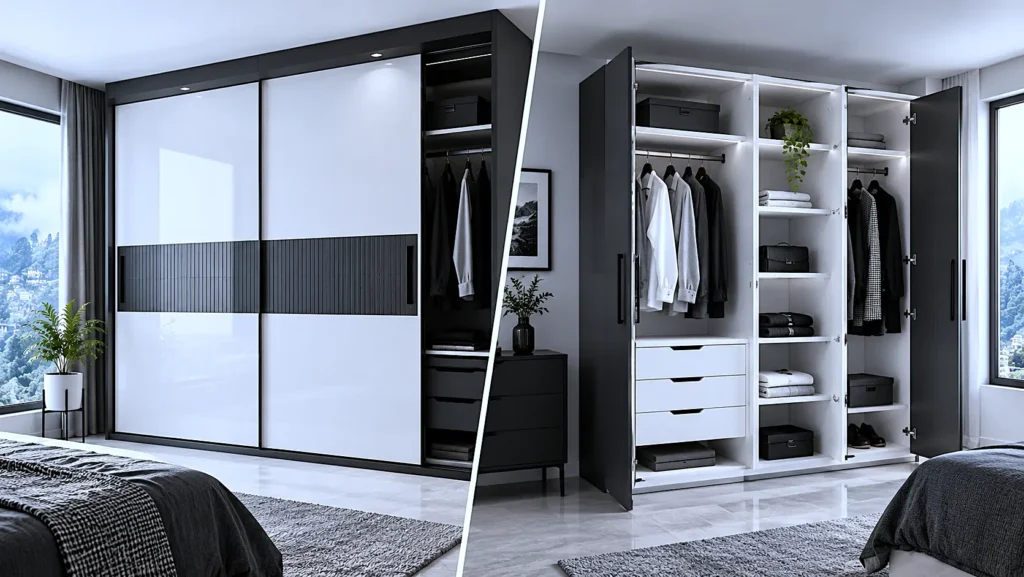
The selection between sliding and open door wardrobes does not lie in which one is more modern. It lies in how you make use of the space.
Sliding wardrobes win on space. They need no swing clearance, which makes them suitable for compact bedrooms where the bed sits close to the storage wall. They also create a clean, continuous face that can make a small room feel less cluttered. The trade-off is that you see only one section at a time, and the track hardware adds cost. A good sliding system from a known brand can start around ₹15,000 or more for the mechanism alone, and cheap local tracks tend to jam or derail under heavy shutters.
Open door wardrobes, which are also known as hinged wardrobes, are less expensive because they use hinges rather than tracks. The open door wardrobes allow you to have a clear view of the insides when both shutters are opened, which is useful in the mornings when you are in a hurry. However, open door wardrobes require clear floor space, usually about two feet in front of the wardrobe, and in a Darjeeling bedroom, such space is not usually available.
Practical tip: if the bedroom space is smaller than approximately 12 by 12 feet, then sliding is the wiser option. If there is comfortable clearance in the bedroom and you want full access immediately, then open door wardrobes should be chosen.
Walk-in Wardrobes and the Darjeeling Storage Ecosystem
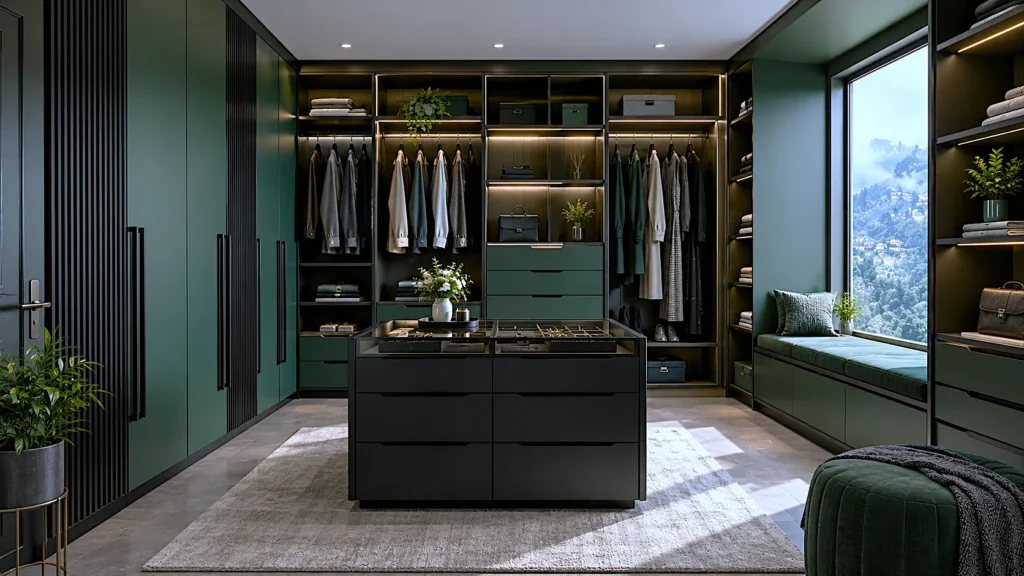
Walk-in wardrobes fall into another class. Instead of a closet with shutters, there is an open dressing room with shelves, rails, and drawers. Walk-in wardrobes in metro apartments can take up 40 to 100 sq. ft. and cost between ₹85,000 and ₹3.2 lakh, depending on size and fittings. In Darjeeling, a walk-in wardrobe is rare due to limited space, but the idea of open storage inspires even a regular sliding wardrobe. Sliding wardrobes with drawers and a mirror section inside become dressing stations in their own right.
Here comes the importance of making a larger furniture choice. A wardrobe is not an isolated piece of furniture; it goes hand-in-hand with the bed, the side tables, and the walkway of the room. For hill houses, custom-made furniture is a better choice compared to ready-made furniture from showrooms since walls may never be completely square and ceiling heights vary. You may have your wardrobe with sliding doors, open doors, or even a combination of both; just ensure that it comes last after your measurement of the room.
Materials, Finishes, and What They Cost in the Market
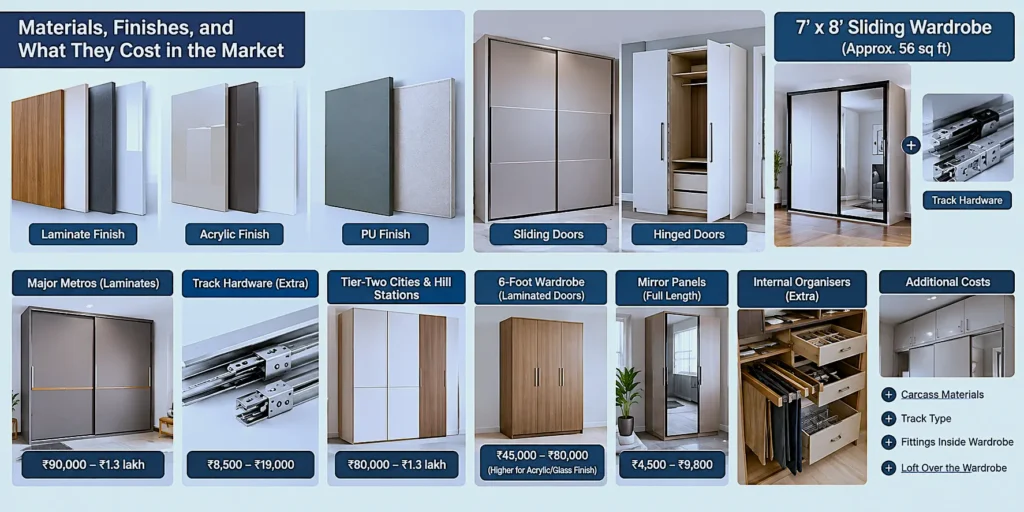
The cost of a wardrobe is calculated based on the per-square-foot area of the shutter face in India. In 2026, for a regular laminate finish, prices lie somewhere around ₹1,200 to ₹1,800 per square foot, while acrylic and PU finish prices are higher. The use of sliding doors makes the wardrobe expensive because the cost of tracks and heavy shutters is higher compared to simple hinges. In the Indian market, sliding wardrobe costs around 15 to 25 percent more than a similar hinged wardrobe.
For a standard size 7’x 8’ sliding wardrobe (approximately 56 sq ft of front area), laminates are going to cost around ₹90,000 to ₹1.3 lakh in major metros, with track hardware costing extra from ₹8,500 to ₹19,000 per brand. These costs may be lower in tier-two cities and hill station markets, where the cost is approximately between ₹80,000 and ₹1.3 lakh due to the difference in labour costs and showroom overheads. For a smaller six-foot wardrobe, the cost would be nearer to ₹45,000 to ₹80,000 for laminated doors, but it will be higher if an acrylic or glass finish is used.
These are approximate costs, and the final cost depends on the nature of the carcass materials used, track type, fittings inside the wardrobe, loft over the wardrobe, etc. The cost of full-length mirror panels ranges from ₹4,500 to ₹9,800, while internal organisers (like trouser pull-outs and jewellery drawers) are extra.
What to Check Before Buying Sliding Wardrobes in Darjeeling
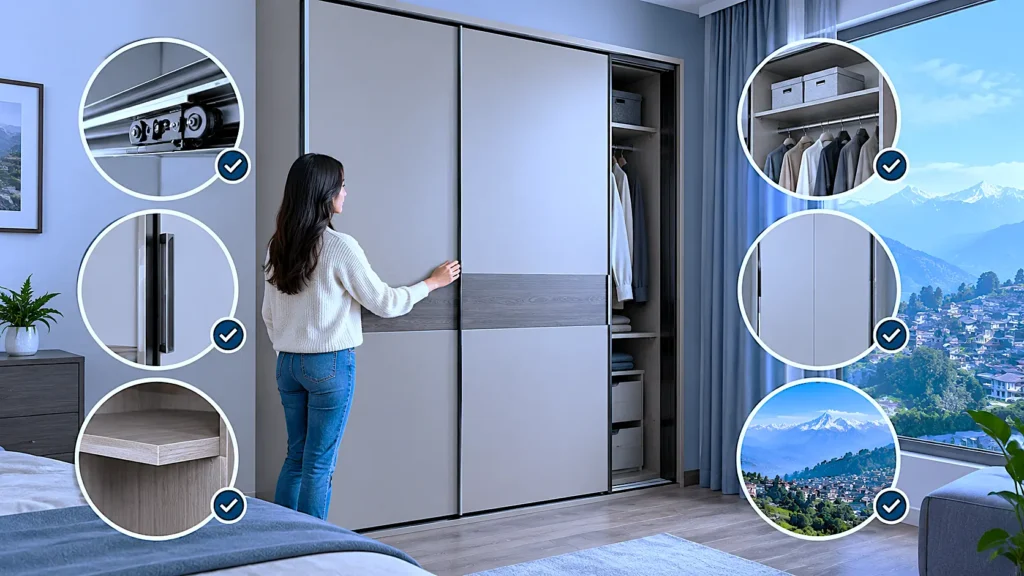
A sliding wardrobe is a machine, and not merely a cabinet. The track determines the degree to which the wardrobe will run smoothly in year one and year seven. In a humid hill environment, dirt and moisture could accumulate in the bottom rail; hence, the track should be cleaned at regular intervals, and rollers should be of high quality. There are three things to know when comparing quotations: what the carcass is made of and its grade, what the brand of the track is, and whether the quoted price includes installation and loft closure.
Another point to consider is the manner in which the wardrobe is affixed to the wall. In Darjeeling, humidity tends to creep through the external walls, and a wardrobe placed directly on a cold and humid wall may grow mold on its rear panel even if it is a moisture-resistant board. A little gap or moisture-proofing behind the wardrobe can go a long way.
SELATO will work with the homeowner to design the wardrobe to suit their individual requirements, and these same concepts apply to any home, be it an apartment or family residence; the first step is to measure the space, select a moisture-resistant core material, and invest your budget into the track and carcass.
Final Thoughts
Sliding Wardrobes in Darjeeling are not a fad. It is an answer to the way hill houses are really designed and used. Small rooms, damp climate, and the need for storage without cutting into the space needed to move about. Open door wardrobes will still be appropriate in bigger bedrooms, while walk-in wardrobes will still be an expensive choice where space permits. However, for the average Darjeeling bedroom, a well-designed sliding wardrobe with a BWP plywood carcass and quality track hardware represents the most practical solution. Make an honest comparison of the materials, demand a breakdown of prices, and design the wardrobe according to the bedroom, not the catalog photograph.